Where understanding connects
A tutor grounded in your school's actual curriculum — a second teacher for every student, in every course, at any hour. Students don't get answers; they build understanding along a living map of connected knowledge.
It asks. It doesn't tell.
Generic AI hands students exactly what they shouldn't have — the answer. Meridian holds it back and asks the next question instead, and a second model reads every reply before it is sent to make sure of it.
Why did the Roman Empire fall?
That's a question historians still debate. Let's build toward it — what internal pressures was Rome facing by the 3rd century that weakened its ability to govern such a large territory?
Political instability? Like they kept changing emperors?
Exactly — the Crisis of the Third Century saw over 20 emperors in 50 years. Now, how might that instability have affected Rome's military defense along its borders?
It can't give the answer away
Even when students beg, bargain, or try to trick it. A second AI reviews every response before it's sent — if the answer leaks through, it gets rewritten as a question.
It answers from your course
Every response is grounded in your actual textbook and materials — searched three different ways to find the right passage. If it's not in the course, Meridian doesn't claim it.
It knows the map
Slope precedes linear equations, connects to rate of change in physics, and becomes the derivative in calculus. The tutor routes each student along that structure, per concept, per session.
The right video, right in the chat
When a student is stuck, a teacher-approved video from channels like Crash Course or Khan Academy appears in the conversation — at exactly the concept they're wrestling with.
It remembers every student
What they've mastered, where they've struggled, how they learn — every session picks up where understanding left off, without the student re-explaining anything.
Over thirty courses. One sheet.
The full AP catalog alongside core subjects — already ingested, concept-mapped, and cross-linked. When a student learns rates of change in Calculus, Meridian knows it matters in Physics too.
Mathematics
- Algebra I & II
- Geometry
- Precalculus
- AP Calculus AB
- AP Calculus BC
- AP Statistics
Sciences
- Biology
- Chemistry
- Physics
- AP Biology
- AP Chemistry
- AP Physics 1 & 2
- AP Environmental Science
Humanities
- English 9–12
- AP English Language
- AP English Literature
- World History
- US History
- AP World History
- AP US History
- AP US Government
Beyond
- AP Psychology
- AP Economics
- AP Computer Science A
- AP CS Principles
- Spanish I–III
- AP Spanish
- and new courses in hours
A 12-year-old and a 17-year-old don't learn the same way.
Three developmentally-tuned personas adjust language, scaffolding depth, and encouragement style to meet each student where they are.
- Language
- Simple words, short sentences, real-world analogies
- Scaffolding
- Heavy — problems broken into two or three small steps, extra hints
- Encouragement
- Frequent praise. Celebrates effort, not just right answers.
- Language
- Standard academic language, technical terms introduced clearly
- Scaffolding
- Moderate — leading questions, independent reasoning expected
- Encouragement
- Balanced. Acknowledges reasoning. Pushes with follow-ups.
- Language
- Full academic register, discipline-specific terminology
- Scaffolding
- Light — synthesis questions, multi-step reasoning expected
- Encouragement
- Treats as emerging adult. Challenges toward deeper analysis.
See the whole class at once.
Teachers see everything — what students ask, where they struggle, and which concepts need reinforcement before the exam. No AI expertise required.
Conversation insights
Every student conversation, visible — what they asked, how the tutor responded, where misconceptions persist over time.
Mastery heatmap
Concept-level view of the entire class. Spot which topics need reteaching before the exam, at a glance.
Curation, not configuration
Approve videos per concept and pin PDFs, links and notes to the concept nodes — students find them exactly where they're needed.
Five checkpoints between a question and every answer.
In the two seconds after a student hits enter, their question passes through five safeguards. Most AI tools have zero.
Is this on-topic?
Off-topic and inappropriate requests are caught before the AI even starts thinking.
What does the course say?
The question is matched against your curriculum — three different ways — so the answer comes from your course, not the open internet.
Who is asking?
Their grade level, what they've already mastered, and where they've struggled shape everything that follows.
Guide, don't tell
The response is crafted as a Socratic question calibrated to that specific student.
Final inspection
A second AI checks the first: no given-away answers, no made-up facts, no wrong reading level.
Compliance isn't a feature. It's the foundation.
No California school adopts a platform that fails these requirements. Meridian was built with compliance as architecture, not afterthought.
Records stay protected
Every access logged. Deletion honored within 30 days. Formal data agreements with each school.
Extra care under 13
Verifiable parental consent before a younger student ever signs in. First names only. No advertising.
Ready for California
Never sold, never used for advertising, never used to build profiles.
Locked at every layer
Encrypted at rest and in transit — scrambled before it reaches our database.
Your school's data is yours
Walled off from every other school. None of it ever trains AI models — ours or anyone's.
Never leaves the country
US data centers only. Independent security audit within a year of launch.
Born inside a real school. Not a tech incubator.
Meridian was built at Ocean Breeze Academy, a California independent school — by the people who run it, teach in it, and advise its students into elite colleges. Every design decision was tested against real classrooms first.

Jill Duoto
Head administrator of Ocean Breeze Academy and the curriculum specialist behind its personalized program — one that meets California State Standards and then goes well beyond them. Every concept map inside Meridian traces back to her curriculum design: what students must master, in what order, and why.
jill@oceanbreezeacademy.org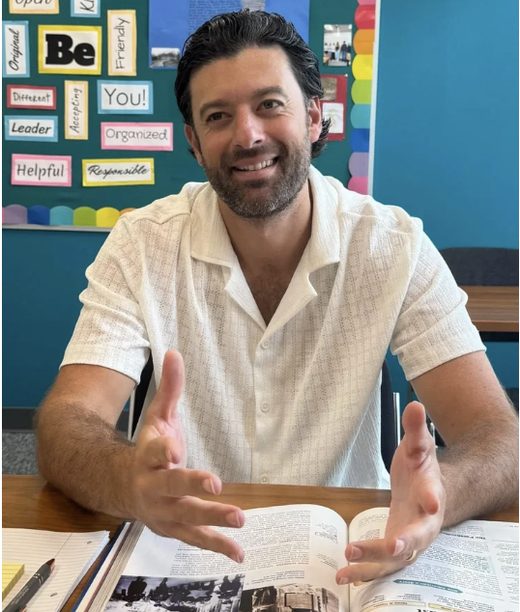
Nick Duoto
Runs every business aspect of Ocean Breeze Academy and personally advises students and parents on course selection and college admissions. He knows which courses matter for which universities, and what mastery has to look like on a transcript — and that fluency is wired into Meridian.
nick@oceanbreezeacademy.org
Ali Khan
A computer scientist and founder of an AI consultancy focused on intelligent systems in deep psychological domains. Meridian began when he built a "second brain" for himself — a visual, connected map of everything he knew — and realized students are handed knowledge as flat lists when the mind stores it as a network.
ali@oceanbreezeacademy.orgBring the map to your school.
We're partnering with California schools for our Fall 2026 launch. Meridian works alongside your existing curriculum — and multiplies what every teacher can reach.
Request pilot access Launching Fall 2026 · California